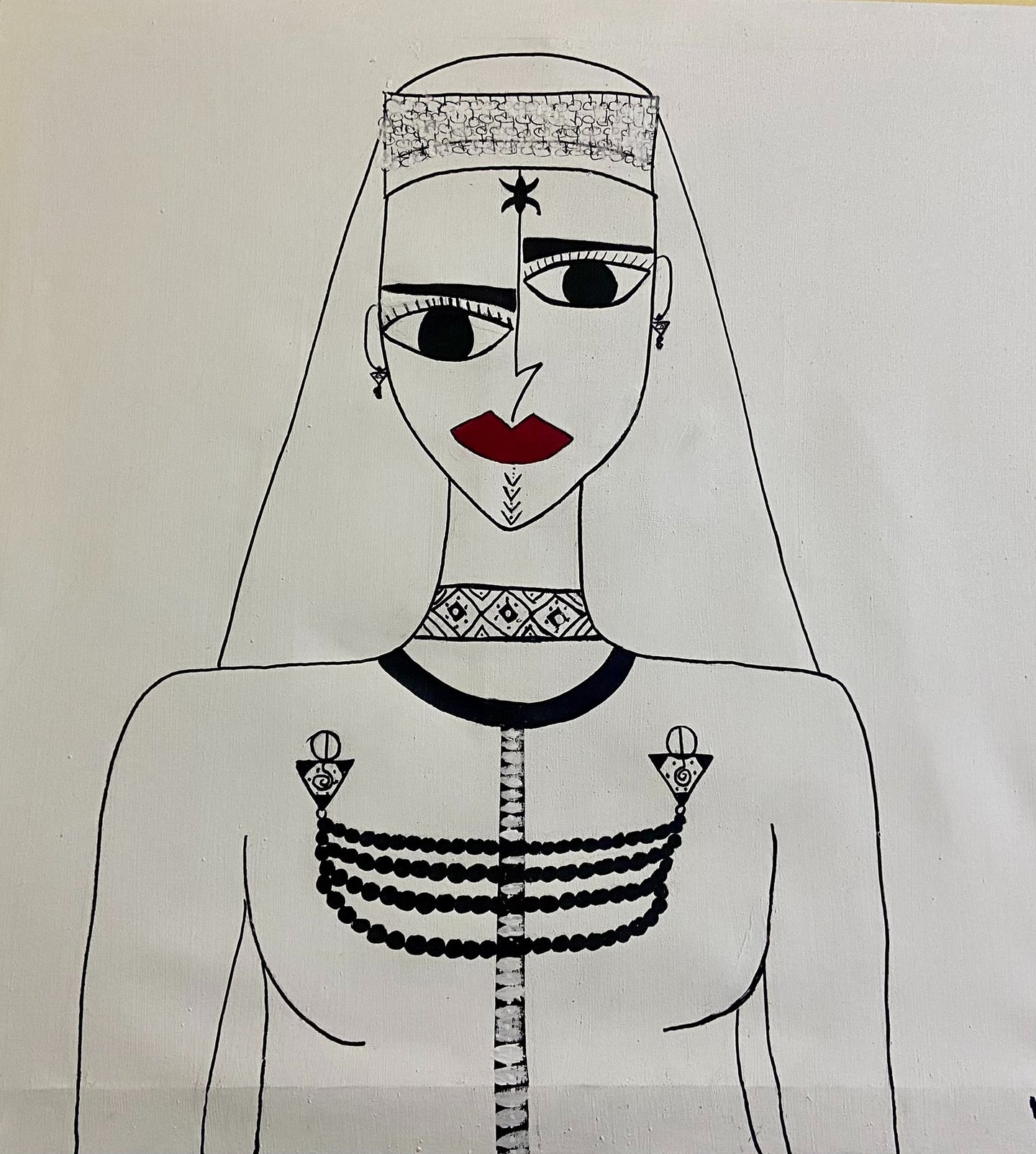
Manifesto of Moroccan Cubism
We are not at a crossroads. We are the crossroads.
European Cubism deconstructed form to reveal a multiplicity of perspectives.
The Moroccan soul has always perceived multiplicity within unity.
Today, these two visions meet and give birth to something new.
Something necessary.
Article 1: We declare the end of opposition.
There is no opposition between geometry and the organic.
Geometry is the bone of tradition.
The organic is the blood of memory.
In Moroccan Cubism, the zellige and the hand that lays it are one.
The rigor of the line and the fluidity of henna merge.
We abolish the hierarchy between intellect and spirit.
Article 2: Our surface is an archaeology.
Each canvas is an excavation site.
We layer strata: the color of spices over concrete gray, ancestral patterns over digital photography, desert sand embedded in acrylic.
Our art does not represent — it exhumes.
It reveals the ghosts of the past that inhabit the present.
Article 3: Fragmentation is our unity.
Western Cubism fragmented in order to analyze.
Moroccan Cubism fragments in order to gather.
Each shard of our composition is a mirror reflecting a different facet of our identity: Amazigh, Arab, African, Mediterranean, global.
Unity lies not in uniformity, but in the rich complexity of assemblage.
Article 4: We re-enchant modernity.
Modernity has grown arid.
It has forgotten storytelling, the sacred, the breath of ancestors.
Moroccan Cubism is a movement of re-enchantment.
It infuses contemporary visual language with the spirituality of patterns, the magic of symbols, the warmth of oral memory.
It restores a soul to the avant-garde.
Article 5: We are the cartographers of a new territory.
This territory is not on any map.
It exists within us.
It is the inner landscape of hybrid identity, of the 21st-century individual—multiple in belonging.
Moroccan Cubism charts this terrain.
It gives form to what was formless: the feeling of being everywhere and nowhere at once.
Of being fully of one’s time, and deeply inhabited by history.
CONCLUSION: A CALL
This is not a style.
It is a stance toward the world.
It is a gaze that chooses connection where others see fracture.
I am not an artist.
I am a translator between eras, an architect of bridges between shores.
To those who feel torn between their inheritances, this movement extends a hand.
To those who believe art has exhausted its paths, this movement opens a new one.
Moroccan Cubism is born.
It was always there, waiting for its hour.
That hour is now.
Mellouki Chaimaa
Founder and Guardian of the Movement